
Blog

Europe’s Future: Inflation and Wealth Taxes

Europe’s Future: Inflation and Wealth Taxes
Profile photo of David Howden

Tax burdens are so high that it might not be possible to pay off the high levels of indebtedness in most of the Western world. At least, that is the conclusion of a new IMF paper from Carmen Reinhart and Kenneth Rogoff.

Reinhart and Rogoff gained recent fame for their book “This Time Is Different”, in which they argued that high levels of public debt have historically been associated with reduced growth opportunities.

As they now note, “The size of the problem suggests that restructurings will be needed, for example, in the periphery of Europe, far beyond anything discussed in public to this point.” Up to this point in the Eurocrisis the primary tools used to rescue profligate countries have included increased taxes, EU and IMF bailouts, and haircuts on government debt.

These bailouts have largely exacerbated the debt problems that existed five short years ago. Indeed, as Reinhart and Rogoff well note, the once fiscally sound North of Europe is now increasingly unable to continue shouldering the debts of its Southern neighbours.
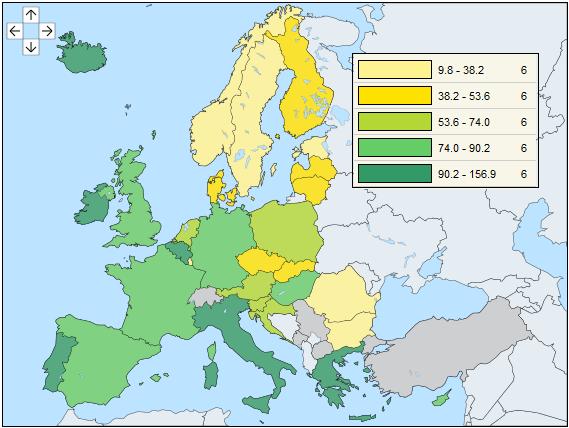
 

General government debt (% GDP) Source: Eurostat (2012)

General government debt (% GDP)
Source: Eurostat (2012)

Six European countries currently have a government debt to GDP ratio – a metric popularlised by Reinhart and Rogoff to signal reduced growth prospects – of over 90%. Countries that were relatively debt-free just five short years ago are now encumbered by the debt repayments necessitated by bailouts. Ireland is a case in point – as recently as 2007 its government debt to GDP ratio was below 25%. Six years later that figure stands north of 120%! “Fiscally secure” Scandinavia should keep in mind that fortunes can change quickly, as happened to the luck of the Irish.

The debt crisis to date has been mitigated in large part by tax increases and transfers from the wealthy “core” of Europe to the periphery. The problem with tax increases is that they cannot continue unabated.
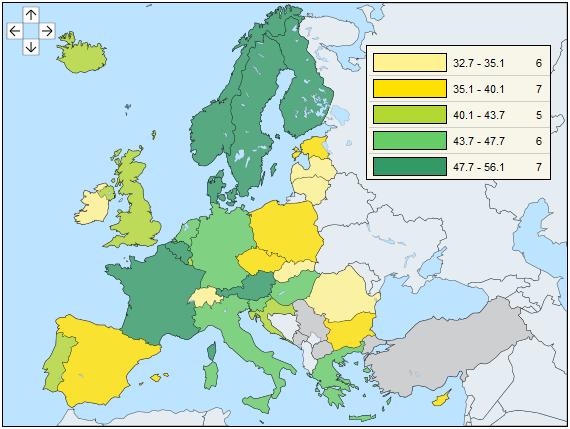
Total government tax revenue (% GDP) Source: Eurostat (2012)

Total government tax revenue (% GDP)
Source: Eurostat (2012)

Already in Europe there are seven countries where tax revenues are greater than 48% of GDP. There once was a time when only Scandinavia was chided for its high tax regimes and large public sectors. Today both Austria and France have more than half of their economies involved in the public sector and financed through taxes. (Note also that as they both run government budget deficits the actual size of their governments is greater yet.)

With high unemployment in Europe (and especially in its periphery), governments cannot raise much revenue by raising taxes – who would pay it? With already high levels of debt it is questionable how much revenue can be raised by further debt issuances, at least without increasing interest rates and imperiling already fragile government finances with higher interest charges.

Instead, Reinhart and Rogoff see two facts of life for Europe’s future: financial repression through higher inflation rates and taxes levied on savings and wealth. This time is no different than other cases of highly indebted countries in Europe’s history – just look to the post-War examples as similar cases in point. Don’t say you haven’t been warned.


Cross posted at mises.org.

  • http://dietaganharmassamuscular.com.br dieta

    I just have to thank you, thank you for posting this article! I was looking on search engines like google and yahoo search things about but was not finding anything! I found this blog and now but could not find what I was looking for! thanks again, was very much in need!

  • http://Leviticus25Plan.org B.Hendricks

    Europe (and America) need a bold, fresh, outside-the-box approach.
    They need a plan that provides equal access to liquidity for citizens at 'ground level' that has been provided to major banking interests over the past 5 years.

    They need a plan that is better than government-run social programs, tax increases and austerity.

    There is one plan that will generate economic acceleration and advance the cause of economic liberty.

    Leviticus25Plan.org

  • Jerry

    There is so much wrong with your solution where do we begin? What is "fair tax"? How do you make various governments comply? By one world government? That is one of the chief advantages of many countries. People and companies move to where conditions and treatment is better. Can you imagine being a victim of one world government? There would be no means of excape. VAT/GST doesn't benefit producers one bit. Governments are the recipients, citizens the victims. Only people pay taxes. Companies must pass on all costs or go out of business. Or excape to friendlier locations.

    About the only thing I can agree with in your post is the need for politicians and the public sector. Fewer is definitely better.

  • Hayrick

    Governments can at least partly solve the problem of tax revenue by ensuring that a fair share of profits stay in the Country. All countries need to come on board so that multinationals, monopolies and clever entrepreneurs based offshore pay a % of sales (if it is not impossible to determine profits and profit taxes). The slamming of the populace with ever higher VAT or GST or whatever you want to call this tax on sales that reimburses producers, is just a protection racket for business and inevitably results in wealth transfer from the poor, or more correctly - impoverishment. The other side of the 'coin' is that "public servants" (and politicians) are made to be exactly that and stop the self serving mandarin benefits that protect them from the damage their policies cause. Fewer would be better too!

Blog
Profile photo of David Howden

David Howden is Chair of the Department of Business and Economics, and professor of economics at St. Louis University, at its Madrid Campus, Academic Vice President of the Ludwig von Mises Institute of Canada, and winner of the Mises Institute's Douglas E. French Prize. Send him mail.

More in Blog

Germans favor a self-destructive policy

Patrick BarronNovember 30, 2016
allison

Trump to pick ex-bank CEO who wants to abolish the Federal Reserve?

Mises CanadaNovember 29, 2016
immigration

The Hidden Costs of Immigration

Mises CanadaNovember 26, 2016
shouting

How to Argue

Danny LeRoyNovember 23, 2016
bannon

Steve Bannon on bank bailouts

Mises CanadaNovember 16, 2016
trump

About last week

Danny LeRoyNovember 15, 2016
ICoPM-1-2016

ICPM Opening Reception!

Ash NavabiOctober 28, 2016

Raising taxes is “tax harmonization”; lowering taxes is “Brutal Brexit”

Patrick BarronOctober 25, 2016

Leithner Letter Nos. 205-208

Mises CanadaOctober 24, 2016