
In order to understand the relationship between money creation and the price level, we first need to get some definitions straight.
To Austrians the terms inflation and deflation refer to money and not prices. There is no doubt that money has experienced unprecedented inflation. In February of 2010 base money was $2.1 trillion. Four years later it was $3.8 trillion. In the same time frame, M1 has increased from $1.7 trillion to $2.9 trillion. M2 has gone from $8.5 trillion to $11.7 trillion. Excess reserves have doubled from $1.2 trillion to $2.4 trillion. (Please keep in mind that prior to 2008 excess reserves seldom were more than a few BILLION dollars, which is effectively zero and represented mostly the aggregate of excess reserve cash in thousands of community bank vaults.)
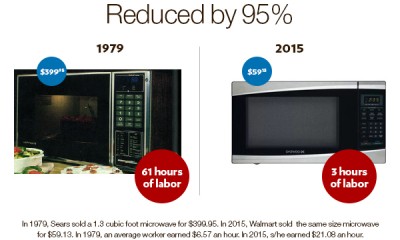
To Austrians changes to the price level, what the public incorrectly calls inflation and deflation, are the result of changes to the aggregate demand for consumers’ goods and the aggregate supply of consumers’ goods. Think of a simple ratio with the numerator representing demand and the denominator representing supply. Notice that an increase in supply will cause the price level to fall. Aren’t we all happy with this? I am. Or a decrease in demand will cause the price level to fall. There can be many causes of a decrease in demand-a fall in the money supply due to bank failures, a change in subjective time preference to save more, or a rational desire to hold more cash during times of uncertainty. None of these are bad for the economy per se. Whatever the cause, the antidote to a fall in demand is falling prices. The relationship between supply and demand must be re-established.
The point I am trying to make is that it is fruitless to attempt to prop up prices with more money creation, as the unprecedented increase in all categories of money in recent years has shown. In fact, excess reserves represent the potential for a massive increase in the money supply. The ratio of mandatory reserves to M1 is around 3%. The ratio of mandatory reserves to M2 is around 1%. Just do the math to find out the mathematical potential increase in the money supply should the banks eventually be able to convert excess reserves into mandatory reserves via the lending process. Keep in mind that this is exactly what the government WANTS banks to do; i.e., make more loans to supposedly stimulate the economy. An increase in the demand for goods of this magnitude, the numerator of our simple equation, would cause the price level to skyrocket perhaps to hyperinflation levels.
Therefore,digging even deeper into our problem, one finds that legal tolerance for fractional reserve banking is at the heart of the problem. Fractional reserves allow banks to create money out of thin via the lending process. Instead of funding an increase in loans by an increase in real savings, loans are “funded” by…well…nothing. This triggers the Austrian business cycle. Production, the denominator in our simple equation, falls. When supply falls, prices rise. Creating even more money will not help the situation, only exacerbate it.
Hyperinflation is a cancer that lurks in our monetary structure. Time to surgically remove it before it metastasizes.




Facebook
YouTube
RSS