

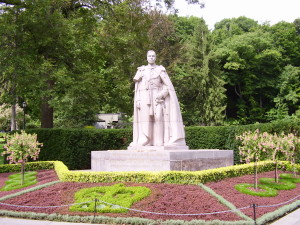
 Last March, I penned a piece titled “Give Me a King” in which I dissected the non-difference between monarchy and democracy’s current form. My premise was simple: If a government “of the people” is hard to differentiate from serfdom, it would be preferable to have a king running the country. That way, at least the guy in charge is playing the long game. It certainly wouldn’t be a solution for upholding rights or preserving a free society. But at least under the crown, as I wrote then, there exists “a clear and distinct social hierarchy.”
In enthusiasm for swapping out democracy for monarchy, it turns out I am not alone. There is a movement within certain policy circles - dubbed “neoreactionaries” - that holds an extreme distrust of majority opinion. This movement, which is led by a crypto-scientist, was once considered fringe but is beginning to gather mainstream attention. In a recent article for Politico magazine, Michael Auslin moralizes on America’s need for a monarch. Despite being a “resident scholar” for the prestigious and warmongering American Enterprise Institute in Washington, Auslin is disgusted by the Capital city. He sees “special interests” and “poisonous partisan gridlock” as terrible plagues befalling the once pristine town of governance. The U.S. President is not just in charge with executing the government’s law; he is also a symbol and head of a political party. This is a terrible nuisance for leading a country as it makes the head executive accountable to the most corrupting influence: the average voter. Or at least, that’s Auslin’s reasoning.
For a District dweller, it’s easy to become disenchanted with what seems like a lack of vigorous action by state authorities. Looking out at the cornfields, the little people appear totally alienated from a sense of national unity. In Auslin’s view they squabble endlessly over who should be president and thus fail to line up like ducks behind whoever holds the Oval Office. Therefore, the country is in desperate need of what he calls a “First Citizen,” a ceremonial figurehead the proles can all gather ‘round to give their blessing. This man-above-men would “be prohibited from any form of governing.” He or she would be a uniter, chosen by the upper echelons of the state.
Why the public would accept a figurehead chosen by a slew of elected officials and appointed judges, Auslin does not say. In his view - which is perfectly typical for an armchair intellectual living in the Potomac bubble - all the people need is a shining star to follow. Behind the scenes, the government will toil away at advancing the nation. So true monarchy, this is not.
Matt K. Lewis finds Auslin’s plan disturbing, to say the least. Writing in The Week, he laments on the waffling influence of America’s founding fathers and their distrust of the imperial crown. Lewis extrapolates this monarchical influence to the formal libertarianism of Hans-Hermann Hoppe where it properly belongs. In his opus Democracy: The God that Failed, Hoppe made the trenchant point that political leaders in monarchies take a less myopic view to domination than their popularly-elected counterparts. More importantly, the inane assumption that “government is us” is wiped out by the throne. If the public does not conceive of itself as part of the governing structure, common folks are less likely to give away their rights and freedom.
That kind of apprehension to power is what makes for an autonomous attitude. Societies composed of individuals suspicious of authority, whether it’s just or not, tend to be more vibrant and thoughtful. Now, suspicion shouldn’t equate to rabid survivalism, but often times it does. Lewis accounts for this mindset by calling it the “atomization and feeling of alienation that is plaguing our nation.” The tacit claim is that anyone who doesn’t firmly bow down to the state are anti-social curmudgeons.
Lewis may not know it, but his sympathies are not too disconnected from Mr. Auslin’s. Both want national leadership, and both want someone competent enough to triumphantly march the nation down history’s path. One believes in the primacy of a natural born leader. The other has his bets with the greater public. Seeing as how modern democracy has morphed into a hybrid mix of economic fascism and wanton brutality dished out by government enforcers, it’s hard to see how monarchy could make anything worse.
The idea of the crown’s return immediately turns most people off. These are individuals who like to think of themselves as independent and self-reliant. They eschew the notion of lordship, but will stand at attention like Pavlov’s dog if some brute barks loudly enough at them. That reaction may appear cowardly, but it’s not unnatural. Some individuals are simply more adept at being leaders than others. Life is full of inequities, some justified and others not. The inherent inequality in social demeanors should not be looked at as nature’s cruel joke. It’s a reality that needs acceptance. As Russell Kirk wrote, “[F]or the preservation of a healthy diversity in any civilization, there must survive orders and classes, differences in material condition, and many sorts of inequality.”
This kind of freedom constitutes what historian David Hackett Fischer called “hegemonic liberty.” That term might seem paradoxical at first, but it’s not wholly incongruous with true human flourishing. Everyone is equal under the law, or at least should be. Unfortunately, many take this equality to mean equal in fortune or ability. This is a fallacy that twists and turns the ego, and begets an envious streak. Coming to terms with the realities of inequity does not diminish the potential for liberty. To the contrary, “knowing one’s place,” as John Derbyshire puts it, in a merit-based hierarchy is freeing. It provides context for harmonious living within a society. The baker, writer, professional athlete, intellectual, painter, mechanic, and movie star all have a role to play in the division of labor. Striving to bring everyone down around you is no way to live contently. Finding peace in order is something cultural Marxists will never achieve. It’s a temperance thing.
That’s not to say monarchy is legitimate by any means. If the choice is between social democracy and a royal bloodline, the latter has more prospects for liberty. After all, kings generally didn’t try to tax a third of their subjects’ income, for fear of beheading. Today, statist politicians are hardly satisfied with stealing just under half of everyone’s wealth.
The Auslinite neoreactionary movement is a funny thing, really. I don’t know if those begging for an objective leader imagine themselves fulfilling the role. If so, the demand comes off as a narcissistic plea for their own aggrandizement. If they are willfully searching for the Remnant to lead them, as well as everyone else, to the Promise Land, that also comes off as pitiful begging. Whatever happened to doing that yourself which others can’t fulfill to your liking?
It’s hard to make out what the goal is for advocates of monarchy. If what the neoreactionaries are seeking is to be part of something bigger than themselves, there is always religion. Looking for meaning in the political is like looking for meaning in a trinket at the bottom of a cereal box. You know what’s coming, and it’s always disappointing. As Noah Millman writes in The American Conservative, the agenda of monarchists is likely driven by a fear “that the American people have failed and needs to be properly directed by the right people” combined also with the idea “that existing privilege cannot be maintained without explicit resort to violence as a political principle.” If that’s true, then the neoreactionary movement is more misguided than originally thought.
Human leaders will exist in this world, as long as the natural inequality in ability isn’t wiped away through violent egalitarianism. But giving over political power to someone deemed too virtuous to corrupt is just asking for trouble. Enough is known about human nature to understand the warping effect of authority. The throne might make for a more stable society relative to democracy, but it won’t guarantee prosperity.




Facebook
YouTube
RSS