

It’s probably a good sign that the attacks on libertarianism are getting even more ridiculous. A recent Salon piece by 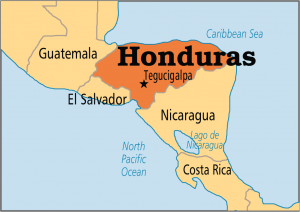 Edwin Lyngar claims that his recent trip to Honduras proves that the principles espoused by people like Ayn Rand and Ron Paul don’t work. (!) Let’s run through this article, just for fun.
Last month, I spent my final vacation night in Honduras in San Pedro Sula, considered the most dangerous city outside of the war-torn Middle East. I would not have been scared, except that I traveled with my wife and our four children…
It was a surreal moment, traveling in one of the most dangerous cities in the world with my babies in tow. I gave a nod to the radio. “Willie,” I said, and he gave me a grin and vigorous “sí.” There’s a lot of American cowboy culture in Honduras, but along with silly hats, Honduras has also taken one of our other worst ideas—libertarian politics. By the time I’d made it to San Pedro Sula, I’d seen much of the countryside and culture. It’s a wonderful place, filled with music, great coffee, fabulous cigars and generous people, but it’s also a libertarian experiment coming apart.
Now at this point, you might be surprised. Have you ever heard any libertarian claiming that Honduras is a paradise, or an experiment in the philosophy? I sure haven’t.
For example, the Fraser Institute’s most recent Freedom index ranks Honduras as the 55th freest country in the world (as of 2012), right behind Botswana and just ahead of Uganda. To be fair, there are other notable countries like Israel and France right next to Honduras in the rankings, so I’m not claiming that it’s a socialist nightmare. But 55th in the world is hardly a libertarian experiment, and most progressives don’t point to France as a Ron Paul ideal.
To get more specific numbers, we can consult the Heritage Foundation’s ranking. In its 2015 Index, Heritage puts Honduras as 116th in the world in terms of economic freedom. It shows that Honduras has government expenditures of 27% of domestic output, and government debt of 40% of GDP. The overall tax burden is 16% of domestic income. The consumer price inflation rate is 5.2%. It’s not North Korea, granted, but it’s hardly the stuff of Atlas Shrugged either.
In any event, let’s move on to the Salon writer’s narrative, to hear in his own words how Honduras shows the flaws in libertarianism:
In America, libertarian ideas are attractive to mostly young, white men with high ideals and no life experience that live off of the previous generation’s investments and sacrifice. I know this because as a young, white idiot, I subscribed to this system of discredited ideas: Selfishness is good, government is bad. Take what you want, when you want and however you can. Poor people deserve what they get, and the smartest, hardworking people always win. So get yours before someone else does. I read the books by Charles Murray and have an autographed copy of Ron Paul’s “The Revolution.” The thread that links all the disparate books and ideas is that they fail in practice. Eliminate all taxes, privatize everything, load a country up with guns and oppose all public expenditures, you end up with Honduras.
It is at least coherent when progressives point to Somalia as an example of the dream of libertarians, because the State really did collapse there. (And that’s why things improved for the Somalis-really.) But Honduras hasn’t eliminated all taxes, privatized everything, and ceased all public expenditures. So it’s hard to see what it has to do with libertarian utopias. You don’t need to take my word for it, either. We’ll continue to quote from the Salon writer to show that his own testimony admits that Honduras isn’t a libertarian experiment.
For example, the very next sentences say: “In Honduras, the police ride around in pickup trucks with machine guns, but they aren’t there to protect most people. They are scary to locals and travelers alike.” So if the government has been disbanded with no taxes and expenditures, and full privatization, then how can there be government police riding around?
What’s happening here is that the author is conflating “libertarians don’t like government doing anything” with “a government doing things badly.” So for example, if (say) North Korean soldiers lined up a bunch of students who were caught plotting against the regime and executed them, our Salon writer would think, “This is applied libertarianism, because Murray Rothbard didn’t like government schools.” But let’s go back to the piece, to the single most absurd paragraph:
The greatest examples of libertarianism in action are the hundreds of men, women and children standing alongside the roads all over Honduras. The government won’t fix the roads, so these desperate entrepreneurs fill in potholes with shovels of dirt or debris. They then stand next to the filled-in pothole soliciting tips from grateful motorists. That is the wet dream of libertarian private sector innovation.
The cognitive dissonance here is astounding. The guy types out that the government “won’t fix the roads,” that private entrepreneurs do the best they can to fix the government’s mess, and then ask for voluntary donations, rather than shaking people down. And this is taken as an indictment of capitalism, rather than the State. Let me ask the author: What would the world need to look like, for the author to think the State had failed in its duties?
Now I suppose the progressives would come back and say, “But you libertarians told us the roads would be beautiful if only private entrepreneurs could run them!” Right. These roads weren’t privatized. The State was still the owner, and the State-according to our author-didn’t maintain them. I’m pretty sure if a multinational corporation came in, repaved the roads, and set up toll booths, the Honduras government-with its military and police-would say, “You can’t do that, those are our roads.” (The Salon writer had linked to this piece, discussing the “neo-liberal” reforms and outside companies coming in. OK, if he wants to say that’s bad, point to some examples of what those companies are doing. Local Hondurans filling in potholes in State-owned roads sure isn’t an indictment of privatization.)
Let’s do one more:
Alberto took me on a small hike to a spot overlooking the city and pointed out new construction and nice buildings. There are new buildings and construction but it is funded exclusively by private industry. He pointed out a place for a new airport that could be the biggest in Central America, he said, if only it could get built, but there is no private sector upside. Alberto made me see the potential, the hope and even the hidden beauty of the place.
Again, the non sequitur here is astonishing. The author looks at new buildings and construction produced by private enterprise. Then he looks at an empty lot, where there is no airport, and argues that this empty lot proves that State funding of infrastructure is superior to private funding.
Let me hit that again from another angle. If there had been a government-funded airport, then it would be coherent to point to it and say, “See? The market wouldn’t have built that.” This is what statists in the U.S. often do, when it comes to football stadiums and dams that only exist because of tax support. There, the proper response is Bastiat’s “seen and unseen.” But at least it’s understandable that people could look at an existing building that the State produced, and count that as evidence in favor of the usefulness of the State.
Yet this writer pointed to an empty lot as evidence that the Honduran government was better at building airports than the private sector.
All in all, I think it’s probably for the best that this guy abandoned his support for libertarianism and is now producing articles for Salon.




Pingback: Weekly Links | Anarcho-bohemianism()
Pingback: The Liberty Crier – Issue #1 – March 11th, 2015 - Liberty Crier()