Measuring Unemployment, Take Two

unemployment lineI recently looked at whether there is a better way to measure unemployment than the standard measures. In it I made two fundamental criticisms about the common measurements of unemployment.

The first had to do with who was counted as “unemployed”. Various measures of unemployment diverge on whether you are unemployed if you don’t have a job, or whether you are only unemployed if you don’t have a job but are trying to find one. From an unemployed person’s point of view, I’m sure it doesn’t matter much whether you’re actively trying to find work or not. What matters is whether you did find work.

My other fundamental criticism had to do with the nature of the unemployment index itself. It is primarily backward looking. People who are out of work don’t care much about what the employment conditions were like in the past. They do care very much about what the job situation is like at that moment when they search for a job.

In short, the common unemployment statistics give a snap shot of the job situation at any moment in time, but it’s mostly irrelevant information. It’s just not the data that people should be concerned with.

To rectify these points I advocated using the steady-state unemployment rate (SSUR), otherwise commonly called the “natural rate of unemployment.” (I avoid using the term “natural rate” of unemployment because it implies that it is natural that people should not work, or work for that matter, and I don’t think that either view is particularly correct.)

The nice result from using the SSUR is that it gives an unemployment rate determined by the hiring and firing decisions made at that moment. In effect it gives a more up-to-date unemployment overview than the other backward-looking measures.

Still, unemployed people shouldn’t care much about the total amount of jobless people in the economy. If you are searching for a job there is a binary result – you either get one or you don’t. Knowing that such-and-such percent of all eligible workers do not currently have a job is little help to you.

The unemployed person is concerned with what the odds are that he will find a job over, say, the coming month. This is a much different question than how many people are currently out of work.

Every month there are some people separated from their jobs. You can think of this as people getting fired, but it is also those who leave their posts of their own volition, e.g., for retirement. There is also a sum of workers who find a new job each month. The SSUR looked at the ratio between those being separated and the total moving into or out of work as a way to gauge unemployment.

We can think of this in other, more useful terms, however.

The difference between the sum of those finding work and those being separated from their jobs is the net amount of new hires in the economy. In March of this year, the United States had a positive balance of 186,000 new hires. Often times this number increases during Christmas time, as stores hire temporary workers to help with the season. For example, in November 2013 there were nearly 260,000 net new hires.

The last month that the United States had net “fires”, that is, more people being separated from their job than finding one, was February 2010, when there were 45,000 more separations than hires.

These net figures are relevant for job seekers. They are also relevant for people with a job.

If the amount of net hires is positive it means that some unemployed people now have a job. If the figure is negative it means that some employed people lost a job.

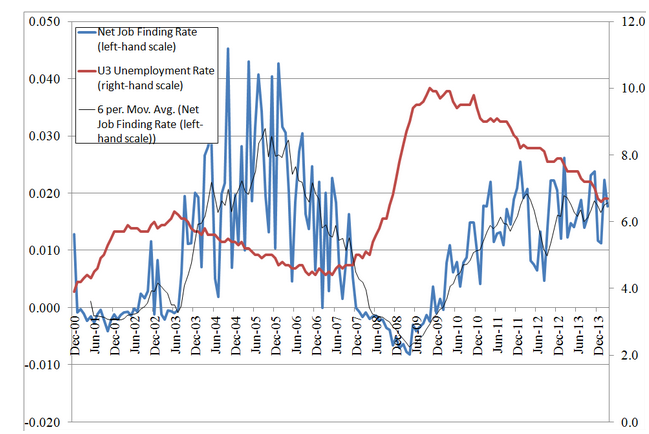
To make sense of these numbers, in figure 1 I have constructed the “net job finding rate” (NJF). When the number of net hires is positive I have expressed it as a percentage of all unemployed people. When the number of net hires is negative I have expressed it as a percentage of all employed workers.

In effect the NJF shows you what percentage of unemployed workers find a job each month, or conversely what percentage of all employed workers lost a job. This is a little more complicated to interpret than the standard unemployment rate, but as we will see it is much more useful to workers.
graph60

Figure 1: Net job finding rate vs. the standard unemployment figure

In recent history, the best month for unemployed workers was October 2004 when 4.5% of all unemployed workers found a job. Not bad. If you were to look at the standard unemployment measure you probably wouldn’t think that was a particularly great month for the unemployed. After all, the official unemployment rate was 5.5%, still quite high relative to the figure two years later at the peak of the boom.

The peak of the employment boom was March 2007, with unemployment at 4.4%. This might be a very low average figure of total unemployed workers, but for the average unemployed people it was not a very productive month. Only 2% of those unfortunate souls found a job that month.

March and April of 2009 were the worst months for American workers in recent history. Each one of those months nearly 1% of all employed people were separated from their jobs. The official unemployment rate was nowhere near its peak at that point, still having two more percentage points to go.

Since the month-to-month number of net hires is quite volatile (because of seasonal industries) I have included a 6-month moving average to smooth the results.

Even though the unemployment rate was still north of 8% in early 2012, the average number of unemployed finding work was a healthy 2%. Today the unemployment rate is lower, but there is also a lower percentage of unemployed people finding work. In short, even though the total employment situation might be better today than it was two years ago, the average unemployed worker is going to have a more difficult time finding a job.

In fact, the average unemployed worker today has about as good a chance of becoming employed as he had back at the end of the dot-com employment recession in mid-2003.

The Net Job Finding Rate is a measure that is actually useful for workers because it reflects the present employment situation. It might be a little more difficult to understand than the common measures, but at least it tells you how likely you are to find a job given current hiring and firing conditions.

Tags: , , , ,

  • http://libertyhq.freeforums.org/ austrianinquisitor

    Sorry - where's the evidence that "lax taxation" - whatever this means when discussing marginal rates of 45% - have contributed to unemployment in this article? This reads as a hack piece against the bogeyman of "neoliberalism".

    "This is not the result of chance. The rise in the fortunes of the super-rich is the direct result of policies. Here are a few: the reduction of tax rates and tax enforcement; governments’ refusal to recoup a decent share of revenues from minerals and land; the privatisation of public assets and the creation of a toll-booth economy; wage liberalisation and the destruction of collective bargaining."

    So where's QE in this list? Magically forgotten? Of course it doesn't fit the narrative of people who'd rather whine about the above being "liberalised".

  • John

    Dear David,

    Can you please list the data sources you use to compute the NJF as well as the SSUR you presented in your earlier article?

    Thank you ver much!

  • Pete Wilson

    I am not an economist (obviously) and do not purport to be, but there are numerous sources supporting the argument that the lax tax rules and other economic policies of the last 2 or 3 decades have contributed to rising unemployment.

    This is very well illustrated in the article at the following link, which includes all necessary citations. http://www.monbiot.com/2013/01/14/bang-goes-the-t

  • David Howden

    Jim Rose:

    I like using that one too, but there's an identification problem of whether falling hours worked is due to recession (people losing their job) or productivity gains (needing to work fewer hours for the same standard of living).

  • Jim Rose

    Edward Prescott doesn't regard unemployment is an economic concept.

    He prefers to measure the state of the labour market with hours worked per working age person.

  • Jerry

    This problem was foreseen and discussed back in 1920, and while the problem has been exacerbated considerable since then, no one seems willing to address the issue, other than the banks that is, by providing ever increasing amounts of interest bearing debt.

    Greenbacker?

  • Jerry

    "As has been clearly proven, the labour content of any modern product or service ranges between 25% to 35% of the total price"

    Every product is ALL labor. The natural resources and land used to produce a product are actually free until it is homesteaded. From that beginning someone's labor is attached to the resource. There is a long string of property exchange and more labor until we reach the final product. None of the products we produce and consume today would appear in nature. For example if we depended on potatoes and wheat for our bread nature would probably support a few hundred people without our labor.

  • guggzie2013

    As with all things, there are conditions that qualify the statistics. To take overall figures, as in your example, they bear no relevance to any particular location or any particular type of employment. Hence, to a large extent, the figures are irrelevant. What is relevant is the statistics relating to the skills of the unemployed person in the location where they live, or where they want to live.

  • guggzie2013

    I didn't say that people do not, or cannot, achieve a reasonable standard of living Virginia. what i said was that they cannot sustain the standard through "normal" employment and wages alone. The vast majority of people have to go into debt to achieve that standard. If the debt is properly managed, it can be a blessing, but it can also be a curse if over done, or improperly provided.
    You are talking in accounting terms, but in the real world, the capital is part of the overheads of any business, along with all the other business expenses, including taxes, inventory, insurance and the profit. If you can show anyone how the wages earned can represent anything like the total cost of any process, i stand corrected.

  • guggzie2013

    I didn't say that people are not, or cannot, achieve a reasonable standard of living Virginia. what i said was that they cannot sustain the standard through "normal" employment and wages alone. The vast majority of people have to go into debt to achieve that standard. If the debt is properly managed, it can be a blessing, but it can also be a curse if over done, or improperly provided.
    You are talking in accounting terms, but in the real world, the capital is part of the overheads of any business, along with all the other business expenses, including taxes, inventory, insurance and the profit. If you can show anyone how the wages earned can represent anything like the total cost of any process, i stand corrected.

  • guggzie2013

    I am not too sure how accurate the 2% figure is for agriculture - if you are just counting the actual farm workers, that may be correct, but to me the "agriculture industry" has to include all the machinery manufacturers, the transport workers, the food processing, the packaging process worker and the 1000 and one other jobs that go to getting food on the table in our cities. The approximate ratio of wages paid in each of those activities always represents only a proportion of the total cost of the service provided, or product produced.

  • Inquisitor

    Still no evidence offered.

  • Pete Wilson

    OK sarcasm taken. What I was alluding to is the issue with businesses these days chasing the bottom line to the exclusion of anything else. This includes share buy backs to inflate their value without making any improvement of the actual business, manipulation of the labour market through powerful lobbying to reduce labour costs to the minimum by laying people off or reducing wages, the very people that they'e marketing their goods to, thereby reducing their potential income. Others in the various supply chains are also affected. This is what I meant by the parasite killing their host. I understand business is there to make money and have no issue with that, but what kind of mentality is it that cannot countenance any inclusion of the wider business and human community in that success?
    I know the narrative these days is totally against state involvement in any business, unless they want a bailout, tax break or reduced safety & environmental standards. But the reality is some things do benefit from state ownership IF competently managed as can be witnessed in Nordic countries for example

  • anoncoward

    In terms of arguing a point, there's no difference between my post about witches and your post about parasites. Neither post offers any form of argument. Neither exhibits any reasoning. They are both intellectually worthless.

  • Inquisitor

    How does it 'prove' this?

  • 1st Family Virginia

    My data times out if I write too much so here is the balance of my comments

    All of this is far afield of the original article which was concentrating of finding a new way of interpreting employment data to determine workforce flow through the unemployment pipeline. To wit, I am not sure that the Net Job Finding Rate is quite what I would want to see. I think a gross job finding rate might be better from the standpoint of someone considering a job change or who finds themselves recently unemployed. How many workers are finding jobs? If 600,000 are finding jobs and 400,000 are losing jobs, the net would be 200,000 but the 600,000 might be a better gauge of the chances of finding new work, especially presented as a percentage of the unemployed or alternatively as a percentage of the job seekers.

  • Pete Wilson

    Care to decipher into something understandable?

  • anoncoward

    It seems to me that there are too many witches casting too many hexes on the labour market. It also seems to prove a case for more witch burnings.

  • anoncoward

    guggzie2013: "As has been clearly proven, the labour content of any modern product or service ranges between 25% to 35% of the total"

    In the USA, only 2% of the population are employed in agriculture. Please explain why there hasn't been mass starvation in the USA.

  • Pete Wilson

    It seems to me that we have a case of the parasite killing their host. It also seems to prove a case for more state ownership.

  • David Howden

    guggzie2013:

    I don't like to use it in the "should" sense that you give. It just doesn't seem the right word for the task. Like you say, one goal is to have as few people working as possible while still having the maximum amount of goods produced. In that sense, I'd love it if the "natural" rate of unemployment was, say, 99.9%. But in the way that it gets used, it's as if it's just natural that some people aren't working (who want to work), and that's what I don't like about it.

  • guggzie2013

    I am not sure what you mean by the following statement, "I avoid using the term "natural rate” of unemployment because it implies that it is natural that people should not work, or work for that matter, and I don’t think that either view is particularly correct." I gather you don't think there is a "natural rate" in relation to the number of jobs that exist, or can exist, or should exist, or that it is "natural" that some people don't want to work, or cannot work? Which scenario are you referring to? There may not be a "natural rate", but there is certainly a deliberately contrived rate for determining the number and type of jobs available.
    I believe, if we take a realistic view of the employment scene over the last 200 hundred years, it is fairly obvious that the thrust has been to produce more with less labour. In other words, to eliminate jobs, which is now being accelerated through automation and computerisation. The motivation for this thrust is again obvious - it is profitability, and as we know, virtually nothing is worth doing unless there is some form of profit to be achieved.
    However, for the past couple of centuries employment has been the principle method for transferring purchasing power to the majority of the population. And it is this majority of the population that represents the bulk of the market for consuming the vast array of products being produced. Thus there is an identifiable link between production and consumption. But, we now have the contradiction of improving the efficiency of production by reducing the labour content, and simultaneously reducing the consumption capacity for the more efficient production.
    As has been clearly proven, the labour content of any modern product or service ranges between 25% to 35% of the total price, including production costs and the profit margin. Hence, it is obvious that most employees on wages or normal salaries, can never earn sufficient purchasing power to sustain an acceptable standard of modern day living without going into debt. That, of course, has been the foundation of the private banking industry through the Government allowing them to provide the money supply to the society as interest bearing debt.